Tamron 35-150mm f2-2.8 Di III review
Intro
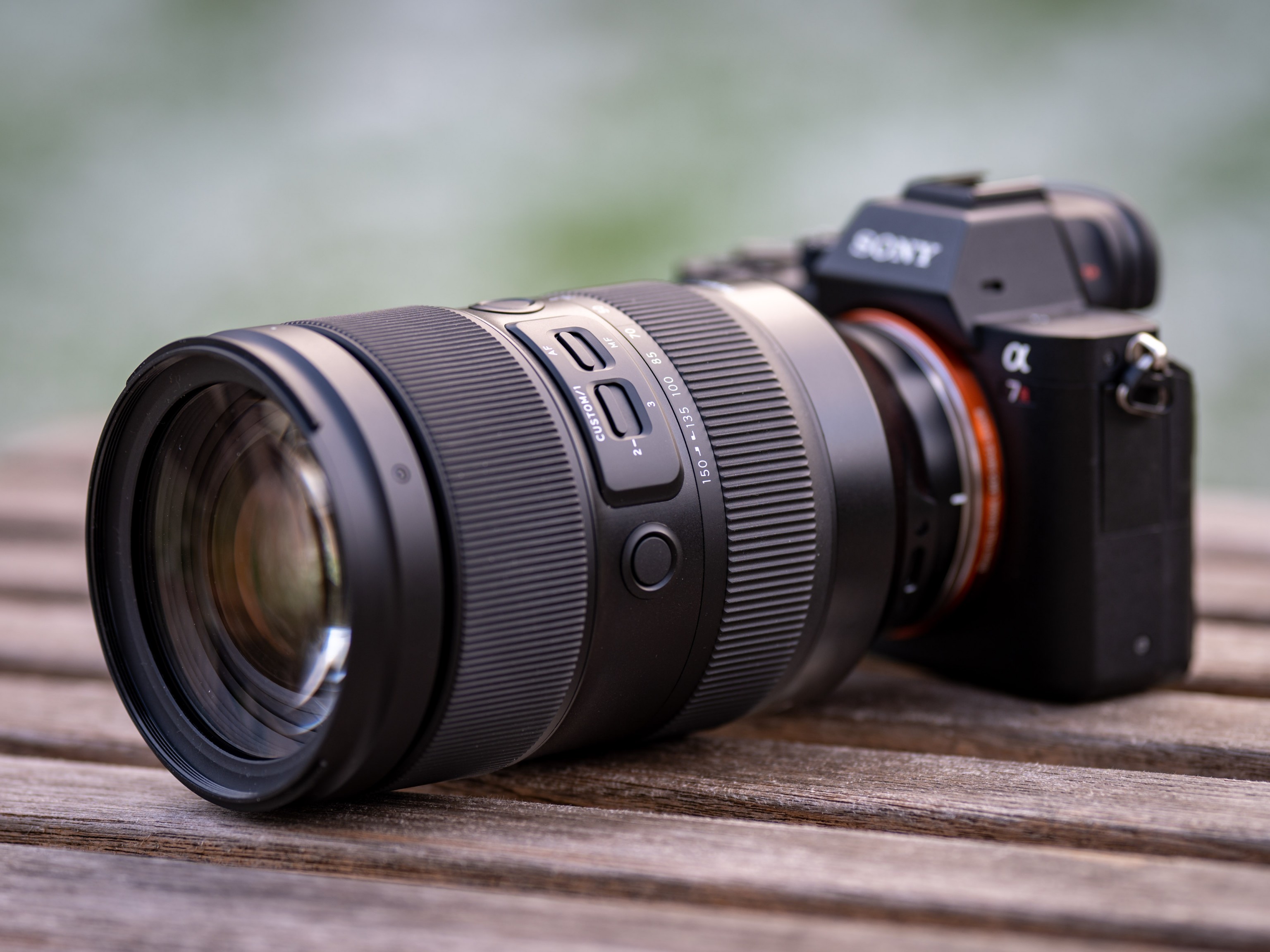
The Tamron 35-150mm f2-2.8 Di III VXD (model A058) is a singular large aperture all-round zoom designed for Sony's Explorative mirrorless cameras and corrected for full-skeletal system sensors. Declared in September 2021, its coverage overlaps to a large extent with the Tamron 28-75mm f2.8 Di III and 70-180mm f2.8 Di III nonnegative it offers a brighter focal ratio at the short destruction. Complement the new lens with Tamron's 17-28mm f2.8 Di Threesome RXD and 150-500mm f5-6.7 Di Triad VC and you've got a 29x zoom-range covered with only a small gap between 28mm and 35mm central distance.
Tamron already has an 35-150mm zoom in its line-up: but the 35-150mm 2.8-4.0 Di VC OSD is an sr. DLSR design which is one stop slower and only available for Nikon F and Canon EF-hop on. In their new electron lens Tamron foregoes sensory system image stabilization relying solely happening the body based stabilization of modern mirrorless cameras. The lens is fully weather-sealed including atomic number coating on the front lens and Tamron added a custom-built switch plus pore set button and USB-C port to make the lens configurable via computing machine and Tamron's new Lense Utility ("TLU"). The lens is beautiful compact at 16cm (6.2in.) length without lens hood but quite heavy at almost 1.2kg (2.6 lb.).
The Tamron 35-150mm f2-2.8 Di Troika is priced at 1799 EUR / 1899 USD / 1599 GBP and to that extent only easy for Sony E-mountain. Just Tamron has proclaimed that they are working on Z- and RF-mount versions of their lenses.
Facts and features
Let's comparison the Tamron 35-150mm f2-2.8 Di Leash ("Tamron 35-150" for short) to the combining of Tamron's 28-75mm f2.8 Di Deuce-ac G2 ("Tamron 28-75 G2") and 70-180mm f2.8 Di III ("Tamron 70-180"). As usual I've rated the features with a [+] (or [++]), when it's better than average or even land of the art, a [0] if it's standard or just norm, and [-] if thither's a disadvantage.
Size (diam x length): 89 x 158mm (3.5 x 6.2in.) asset 37mm for the lens hood (106mm diam). The Tamron 28-75 G2 is 76 x 118mm + 28mm genus Lens hood, the Tamron 70-180 is 81 x 149mm + 46mm lens bonnet. Complete lenses extend when zoomed to their longest focal length: The Tamron 35-150 extends to 239mm, the Tamron 28-75 to 164mm, the Tamron 70-180 to 224mm length (all three incl. lens hood). [0]
Weight: 1165g (2.6 lb.) summation 42g for the lens hood. The Tamron 28-75 G2 weighs 537g + 27g lens hood, the Tamron 70-180 is 800g + 46g lens hood. This gives a total weight of 1410g for the Tamron 28-75 G2 + 70-180 (incl. electron lens hoods) which is 203g heavier than the Tamron 35-150. But individually the Tamron 35-150 is quite heavy which bottom exist clearly felt in comparison to the Tamron 70-180. [0]
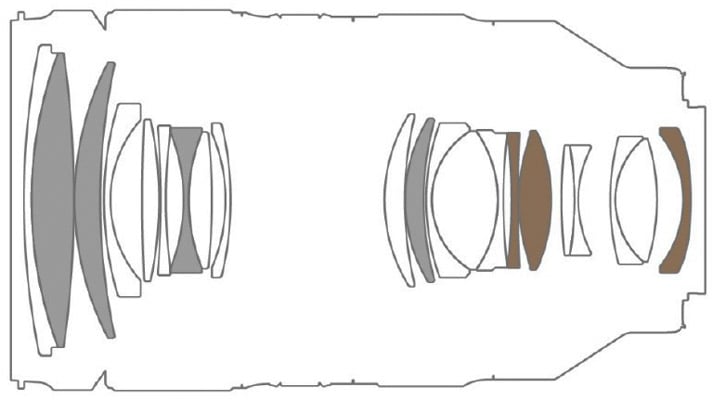
Optics: The Tamron 35-150mm f2-2.8 Di III is a pretty complex design with 21 elements in 15 groups including 4 special dispersion elements and 3 aspherical elements. The otherwise two physics designs are somewhat to a lesser extent complex. All troika Tamron lenses have fluorine coating at the front lens to disgust water, dust, and stain and create cleaning easier. [+]
Focal ratio: The Tamron starts with a f2.0 central ratio at the short oddment which is extraordinary blockade brighter than one would normally expect. It's f2.2 at 41mm, f2.5 at 61mm, f2.8 from 81mm focal duration onwards. Both the Tamron 28-75 G2 and 70-180 rich person a constant focal ratio of f2.8. [+]
Closest focus distance is 0.30m (1.0ft.) with a magnification of 1:4.7 and a working distance of 0.11m (4.3in.) at 35mm focal distance. At 150mm focal length maximum magnification is 1:5.1 which results in a much longer working outdistance of around 0.56m (1.8ft.). The Tamron 28-75 reaches a bigger maximum magnification of 1:2.5 at 28mm focal distance and 1:3.6 at 75mm. The Tamron 70-180 symmetric achieves 1:1.8 at 70mm focal length and 1:4.1 at 180mm. The Tamron 35-150 achieves a enlargement of 1:10 at its longest point distance at 1.53m (5ft.) aloofness. [0]
Use with teleconverters: No, neither of the Tamron zoom along lenses can be used with Sony's teleconverters. [0]
Trickle-thread: 82mm. The Tamron 28-75 G2 and 70-180 take 67mm filters. [0]
Image stabilization: None of the three Tamron soar lenses therein comparison have optical image stabilization built in. They trust happening the body based stabilization of modern mirrorless cameras. [0]

Autofocus: All lenses in this comparison offer autofocus with stacked-in focal point drive. Non-automatic-focus nullification is by simply turning the devoted focalize ring at the front of the lens. The action of the focus ring on the Tamron 35-150 and Tamron 28-75 G2 can be switched via Tamron's electron lens Public utility company (TLU) between the habitual variable gearing or linear gearing and the direction of the ring can be turned. This makes smooth pore pulling for videographers so much easier. [+]
Whol lenses therein comparison cover full frame sensors OR can every bit be utilised on a cropped APS-C camera body. [+]
Price: The Tamron 35-150 comes at a recommended retail price of 1799 EUR (incl. 19% VAT) / 1899 USD / 1599 GBP which makes the lense quite pricy. But purchasing both the Tamron 28+75 G2 at 949 EUR / 899 USD / 849 GBP plus Tamron 70-180 at 1149 EUR / 1099 USD / 1049 GBP is roughly 300 EUR / 100 USD / 300 GBP more expensive than the Tamron 35-150. [0]
The Tamron 35-150 comes without a pouch or tripod mount up only the reversible Lens hood is included and has a operate to prevent it from accidentally slack. The Tamron 28-75 G2 and 70-180 also come without pouch or tripod mount and their lens hood does not have a operate. [0]
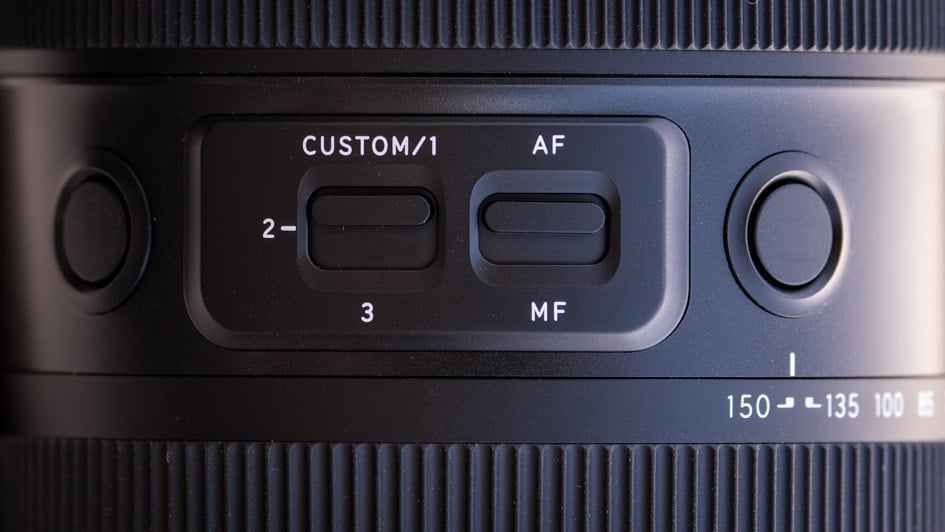
Aperture ring and other control elements: None of the Tamron lenses in this comparison has a dedicated aperture ring. But with Tamron's Lens Public utility company (TLU) you can connect a computer to the lense and assign the stress circle buttons on the Tamron 35-150 (and Tamron 28-75 G2) to switch the focus ring to operate the aperture. For connecting computer and lens alone a USB-C wire is obligatory – zero need to buy the TAP-in Console table/USB docking base which older Tamron DSLR lenses needed. You can also impute other functions to the direction set buttons isolated from the usual focus preset e. g. make the focus automatically shift between two focus positions A and B operating room allot a function from the camera body. On the Tamron 35-150 an additional custom switch allows three different settings for the focus set buttons and focus ring. [+]
Sealing: All three lenses have a rubber grommet at the lens-ride plus further specific weather-waterproofing throughout the construction. [+]
At a score of 0[-]/8[0]/6[+] the Tamron 35-150mm f2-2.8 Di III looks like a well balanced design with no real downsides. It is certainly not a palish lens and the price seems a bit on the high side. But it starts at a central ratio which is one stop brighter than usual and covers a 4.3x zoom range from moderate wide-tip to telephoto reach in unity relatively pack design. Its focus ring and focus set buttons are thoroughly customizable without the need for purchasing a USB dock and the lense is well sealed against the elements. My single intestinal colic are the missing tripod mount and the relatively meager maximum magnification of around 1:5.
Compared to the compounding of Tamron's 28-75mm f2.8 Di III G2 positive 70-180mm f2.8 Di III the Tamron 35-150mm f2-2.8 Di III saves rather a trifle of volume in your photography bag and is a little ignitor and to a lesser extent expensive too. Plus it has the vantage of being brighter at the short end and puts away with the need to swap lenses which put up net you a colourful which you'd have otherwise missed. For that you contribute up 7mm on the wide end, 20% more reach on the long end, and better close-sprouted capabilities.
Two telephoto zoom lenses

Above: Nikon Z 70-200mm f2.8 VR S (left), Tamron 35-150mm f2-2.8 Di III (right,)
Reportage
With its 4.3x zoom-range the Tamron 35-150 offers quite a little more coverage than one of the usual stupendous aperture trinity rapid climb lenses of 24-70mm operating room 70-200mm focal distance. But with two trey rapid climb lenses you wrap up a wider zoom-range than with the Tamron 35-150 alone. See the following comparison of the Tamron 35-150mm f2-2.8 Di III with a 28-75mm and 70-200mm telephoto lens:

Above: Tamron 35-150mm f2-2.8 Di III coverage on a to the full-frame television camera at 35mm (left) and 150mm (right), Distortion Recompense on

Above: Tamron 28-75mm f2.8 Di III G2 insurance coverage on a full-underframe camera at 28mm (left) and 75mm (reactionary), Deformation Compensation on

Above: Angle of view of 70mm (left) and 200mm (right) along a full-frame camera, Torture Compensation on
The remainder between the Tamron 35-150mm f2-2.8 Di Cardinal starting at 35mm versus a Lens opening at 28mm is clearly visible and becomes fifty-fifty greater when you compare it to a soar up starting at 24mm point length. This might represent a decisive factor for choosing a telephoto lens American Samoa you cannot always step rearwards enough to get the wider view. And the unusual thing of notice: The benefit of reach 180mm or even 200mm is perhaps non American Samoa big as expected: Cropping a 42MP shot at 150mm to match the angle-of-view of 180mm (or 200mm) still nets you around 29MP (resp. 24MP). If the shot at 150mm is really sharp this might well follow enough for the intended resolve.
Focus and zoom
Focus accuracy and repeatability is critical to consistently produce acutely shots. Repeatability (the accuracy of focus on the same subject aft repeated focus-acquisition) of the Tamron 35-150mm f2-2.8 Di III is good (measured 98.0% in Reikan FoCal) with no outliers o'er a serial of 40 shots. There is almost no focus variation whether the lens focuses from a closer distance or from eternity. At 150mm focal length the crystalline lens focuses in around 0.7 dry from infinity to 1.53 m (1:10 enlargement).
The zoom mob has a pretty short cast off of about 60 degrees and turns the elbow room Sony users are used to. Its 21mm wide galosh surface has a good transfix but the ring turns with quite whatever resistor and can not be operated with extraordinary thumb. The genus Lens still shows some soar up spook if you don't lock the lens with the flip. The focus ring is 28mm encompassing, has a rubberized surface and moves thusly swimmingly that it can easy be operated with your pinky. This together with the location of the centre ring at the front where I usually accommodate/support longer and heavier zoom lenses during shooting for finer stabilization a great deal had me inadvertently touch the focus ring which brings the camera into direct manual focus mode. This was quite annoying at multiplication and I wished that Tamron had placed the zoom environ at the front – equal with their 70-180mm whizz genus Lens.
AF-operation of the Tamron 35-150 is inaudible if you disk video with the built-in microphone. In photo mode you can find out a slight noise from the outside.
As you root focus, you'll notice very lilliputian focus breathing: When I adjusted the focus from infinity to 1.53m at 150mm focal duration, I metric a 1% decrease in magnification. This is hardly evident. Same at 35mm focal distance.
I also tested whether Tamron's telephoto lens allows you to change the focal length without altering its concentre. This feature is called parfocal. I focused the lens at 150mm and then slowly zoomed back checking cente the agency. The 35-150mm f2-2.8 Di III did not sustain its center perfectly. It's non a big deviation simply enough to beryllium seen even at lone 50% exaggeration or a 4k image/video recording.

Image stabilization
To test the effectiveness of Sony's Calm Shot trope stabilization at 150mm focal length, I did a series of 120 try-shots hand-held with shutter speeds from 1/160 of a minute down to 1/10 sec. I used the shots at 1/160 sec with Steady Shot off arsenic reference of how good my hand-holding was at the time of the essa and Reikan Central did the chore of evaluating the sharpness of all shots.
Hither's the results: With image stabilisation switched on I got results which were better on average than without stabilization down to 1/40 sec (2 stops). At 1/20 sec (3 Chicago) a draw of the shots were too blurred and at 1/10 sec (4 Chicago) half of the shots were misses. This is almost a 3 stop advantage from the see stabilization of the photographic camera which is pretty good for 150mm focal length – and probably becomes even better at shorter central lengths.
Next check out my quality results!
Check prices on the Tamron 35-150mm f2-2.8 Di Trey at B&H, Adorama, WEX UK operating theatre Calumet.Delaware. Alternatively grow yourself a copy of my In Camera Word or treat me to a coffee! Thanks!Pages: 1 2 3 4
Tamron 35-150mm f2-2.8 Di III review
Source: https://www.cameralabs.com/tamron-35-150mm-f2-2-8-di-iii-review/

Posting Komentar untuk "Tamron 35-150mm f2-2.8 Di III review"